

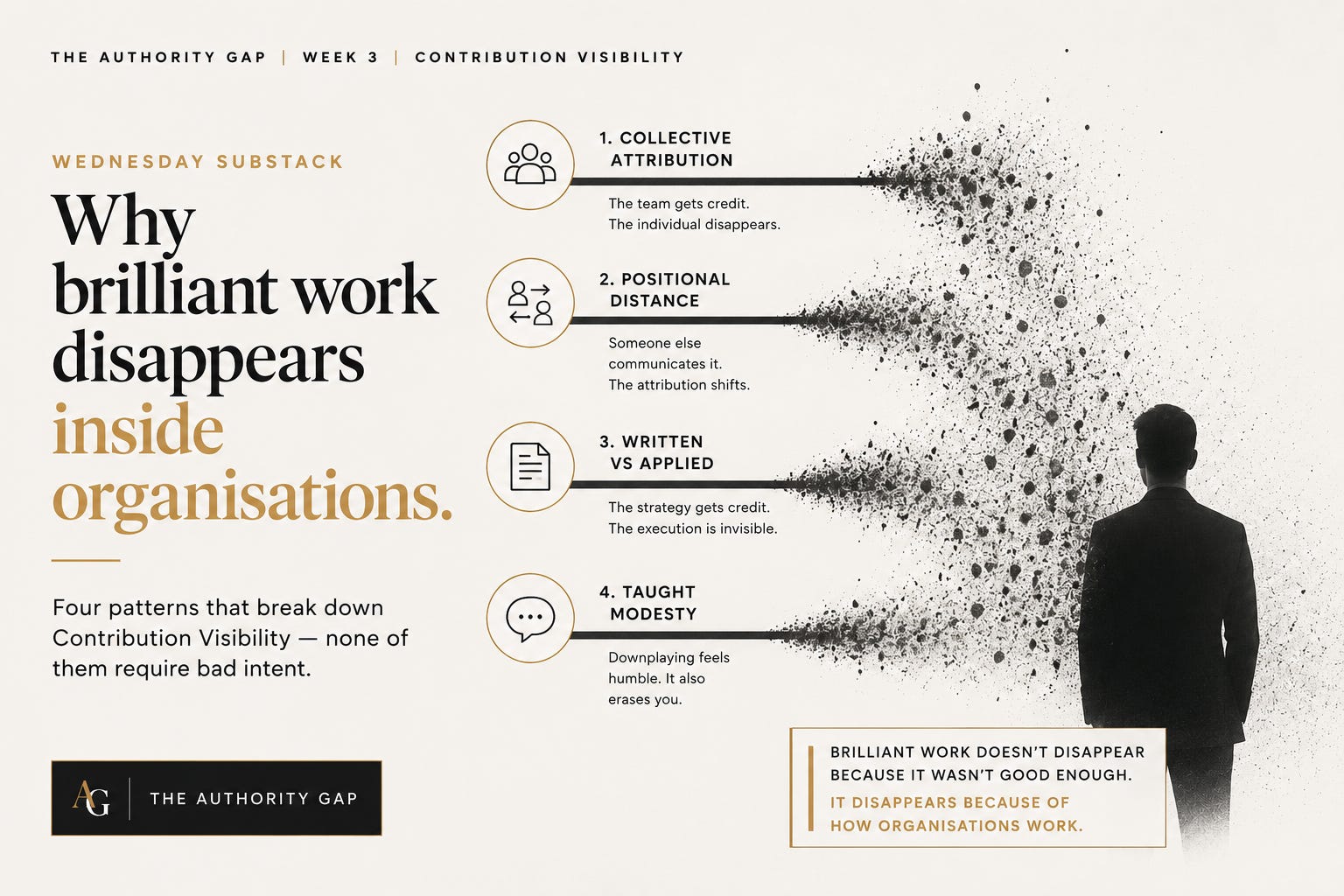
Why Brilliant Work Disappears Inside Organisations.
Four patterns that break down Contribution Visibility, none of them require bad intent.

As a professional you are not doing anything wrong. That is what makes this particular pattern so persistent.
You were being collaborative. Using “we” language because the team did contribute. Not overclaiming, not self-promoting, not doing the thing that gets quietly resented in most organisations. You were describing their work accurately. You were also, systematically, erasing the specificity that makes contribution attributable.
This is how Contribution Visibility breaks down most often.
Not through neglect.
Through habits that are professionally appropriate and structurally self-defeating at the same time.
Four Patterns
The first is collective attribution. You consistently describes your work in terms of the team’s result rather than your specific role in producing it. The team delivered. The project succeeded. All of that is true.
What is absent is the individual contribution: which decisions this person made, what they navigated, what changed because of their specific involvement.
In most organisations, collective attribution is the safe and collegial choice. It is also the choice that makes individual contribution invisible.
The second is positional distance. Contribution Visibility breaks down when the person who delivers the work is not the person who communicates it.
The analyst produces the findings; someone else presents them. The project lead makes the decisions; someone else writes the summary. The thinking lives in the execution; the report attributes it to the strategy.
This does not require bad intent. It only requires that the communication and the doing are done by different people.
The third is the written-versus-applied problem. The person who writes the strategy document is credited with the strategy. The person who takes that hypothesis into the field, reads what is actually happening, adapts in real time, and makes hundreds of invisible decisions that determine whether the strategy survives contact with reality, that person is credited with implementation.
The thinking embedded in execution is often more sophisticated than the document that preceded it. But it disappears into the result rather than being attributed to the person who produced it.
The fourth is taught modesty. Many professionals have been explicitly or implicitly trained that claiming credit is self-promotion and therefore inappropriate.
The instinct is collegial. The structural effect is to remove the author from the work.
The Compound Effect
What makes these patterns hard to disrupt is that they look like professional virtues from the inside.
Being a team player.
Not overstepping.
Letting the work speak.
They are virtues, in a sense. They are also the mechanism through which strong performance produces weak positioning.
The professional who has been operating this way for years does not have a sudden gap to address. They have a track record that is real, consistent, and undifferentiated.
Lots of evidence that something good happened.
Very little evidence of who specifically made it happen and what they specifically changed.
When they arrive at a promotion conversation, or a moment when they need to make a case for themselves, the problem becomes visible. They know what they have done. They cannot state it in a way that lands. The evidence is there but it was never structured to be retrievable.
Strong Reputation. Weak Case.
This is the compound effect of low Contribution Visibility. It does not announce itself. It accumulates quietly, one undifferentiated description at a time, until you have built a strong reputation and a weak case.
I’m Mornay
Strategic Advisor and Founder, Yabda Collective
I created The Five Advancement Signals, a diagnostic that identifies the structural signals determining whether contribution is recognised, trusted, and translated into advancement.